THE HISTORY OF HENDEN
The History of Henden
Introduction
Henden is a medium sized estate in West Kent, steeped in history, much of it associated with Royalty. Doing the research into its past has been fun. Records are often difficult to work out, but we like to think that what follows is a faithful history of our home.
Plantagenet times
Henden is one of the oldest estates in the Ide Hill area, an area which was originally called Edythshill. The estate was part of the Manor of Sundridge, which lay within the “lathe” (an old Kentish administrative division) of Sutton-at-Hone near Darenth in West Kent.
The land around Henden started life over a thousand years ago and would have been part of an ancient forest and “dens” (woodland pastures used for the grazing of pigs). The lands sat at a strategic high point, Ide Hill being one of the highest points in Kent. They were likely used for agriculture, timber and charcoal production as well as pigs for the Crown. The high altitude of the ridge, the first in the Weald from the North Downs was useful for signalling beacons to London.
In time, Henden became an independent Manor, recognised as such in “ancient writings”. Edward Hasted, who wrote a History of Kent in 1797, describes Henden as formerly being “a member of the manor of Broughton Aluph” in Kent, located some 40 miles away near Ashford. This suggests an old feudal connection, which possibly dated back to the Norman period.
Between the reigns of King Henry III (1216–1272) and the late 14th century, the estate was gifted by the Crown to several high-ranking figures for their military and political services. They were “King’s Men”, who helped run the country during the Hundred Years’ War.
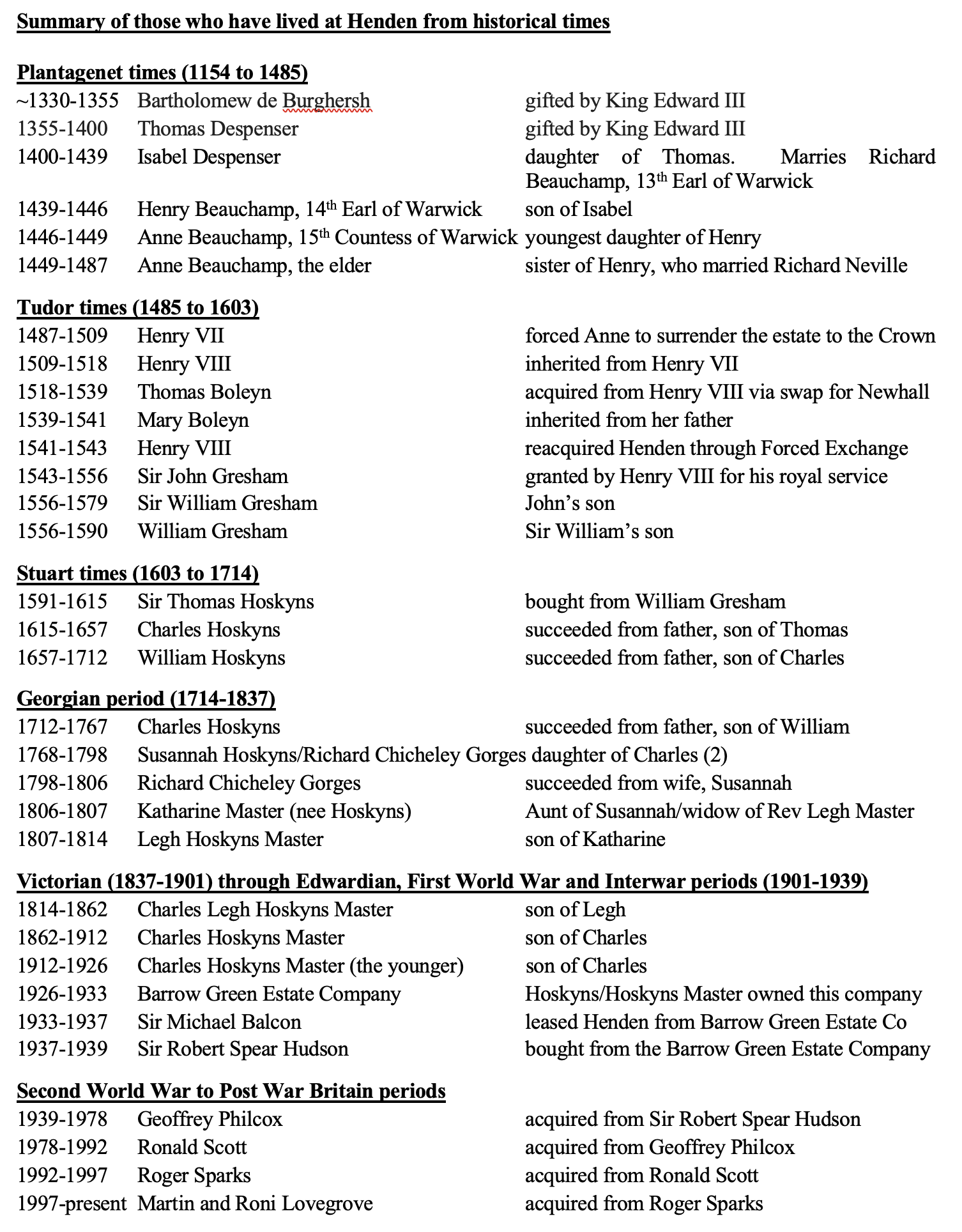
In the mid 13th Century Henden was gifted to Bartholomew de Burghersh the Elder. De Burghersh was a particularly influential owner of Henden. He was the Warden of the Cinque Ports, effectively controlling the main channel of communication between England and France. More broadly in 1337, King Edward III made de Burghersh Admiral of the Fleet from the mouth of the Thames westward, Constable of the Tower of London and Lord Chamberlain of the Household. During this period de Burghersh held a Manorial Court at Henden where as Lord of the Manor he had the right to judge over local disputes and manage tenant farmers who worked the surrounding land.
It was likely that around this time the moat surrounding the house was dug. Such moats were dug not just for defence, but as a symbol of status and manorial authority. It was also a place for sewage to settle.
De Burghersh died in 1355 and Henden came under the ownership of the Despenser family, one of the most ambitious but ultimately tragic families of the Middle Ages. Thomas Despenser was the Earl of Gloucester and a close ally of King Richard II. In 1399, King Richard was overthrown by his first cousin, King Henry IV. Despenser participated in a plot to overthrow King Henry IV, a period called the Epiphany Rising. This plot failed and ultimately Despenser was caught by a mob in Bristol as he tried to flee west. He was executed on 13th January 1400 and his head was sent to London for display. Upon his death Henden’s ownership passed to his daughter, Isabel Despenser. She married Richard Beauchamp, the 1st Earl of Worcester in July 1411 at the age of 11. In 1422, having given birth to one daughter, her husband died and she married his cousin Richard de Beauchamp, 13th Earl of Warwick by whom she had two children, Henry and Anne de Beauchamp. Anne later married Richard Neville, also known as “Warwick the Kingmaker”. Around this time and through to the 16th Century Henden was described in country records as a Royal Manor.
As one of the most powerful men in England at the time as well as being a commander in the French war, it is almost certain that Richard de Beauchamp did not visit Henden. This would seem to confirm the story that over the time 1400 to around 1480 the manor fell into a state of disrepair. This happened to many secondary manors in the Weald at that time.
At some time between 1450 and 1470 the original manor house is believed to have been burned to the ground. The cause is unknown. One possible reason, perhaps the most likely, is that, given Henden was owned by the Earl of Warwick family during the Wars of the Roses (1455-1487), the property became a target for seizure and destruction by Lancastrian or Yorkist raiding parties depending on the year. Another possible reason, given that the house was built of oak frames and wattle and daub infill, is a spark from an open central hearth or from the kitchen set the building alight.
The areas that survived this likely fire include the moat and “the cellars”, which lie below the service wing of the current, brick-built house to its west. The cellars comprise Kentish Ragstone stonework foundations. (The “cellars” are not cellars as you and we might think as the land around Henden is really quite wet during the winter months). In addition, the stone bridge over the moat remains intact below what is today a brick section on either side of it.
Tudor times
Anne, Countess of Warwick, was forced to surrender the estate to King Henry VII in 1487, which records suggest was treated as a high value estate in part because of the deer park associated with it. The King appointed a high-ranking Kent loyalist to oversee the estate and the rebuilding of the Manor house. This man was possibly Sir Richard Guldeford (Guildford), a central figures in the King’s court (Comptroller of the Royal Household) and the Sheriff of Kent (1493-94). He had exceptional architectural expertise and was one of the King’s most trusted engineers and builders. He was, for example, involved in draining Romney Marsh and building defensive structures. He was often tasked with managing and improving Royal estates in Kent.
Another possible administrator was Sir William Scott, a powerful Knight and Sheriff of Kent in the 1490s. The Scott family were frequently “Keepers” of Royal parks and Manors in the region. Henden was highly valued at the time largely for its deer park (Henden Park).
The rebuilding of the Manor house was likely financed by a wealthy person looking to impress the King and the likes of Sir Richard and Sir William. Such a person could have been the wealthy Mercer and Lord Mayor of London (1488) Robert Tate. Interestingly here, Robert’s daughter, Philippa, married Richar Guldeford’s son. Anyway, whoever did the financing will likely have lived in the house.
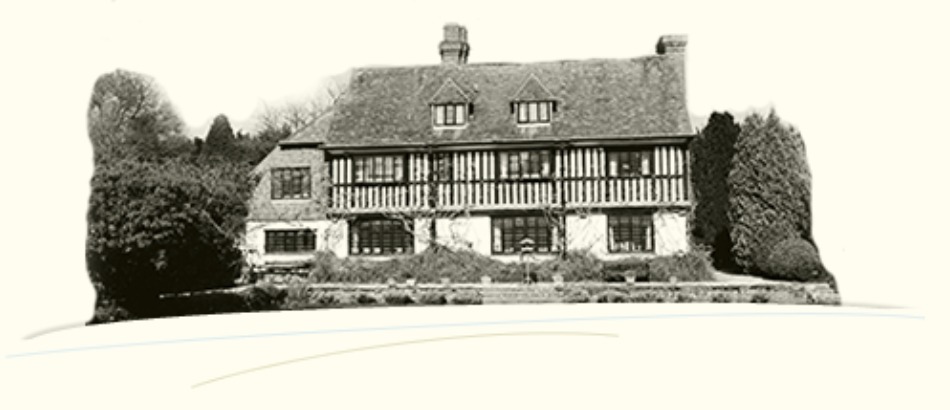
It is understood that the redevelopment occurred in the years 1487-90 with the site encompassed by the moat being cleared and a high-status Tudor “Wealden Hall House” being built. The new house was built on a slightly different alignment than the foundations of the original house within the moated area. It was built as a great hall, the central roofed room being for dining and business. The private wing for the family was off to the side and is sometimes noted as being “the solar wing”. The core of the house was built using massive Wealden oak beams. Unlike the previous stone fortresses, this rebuild was designed for comfort and administrative show.
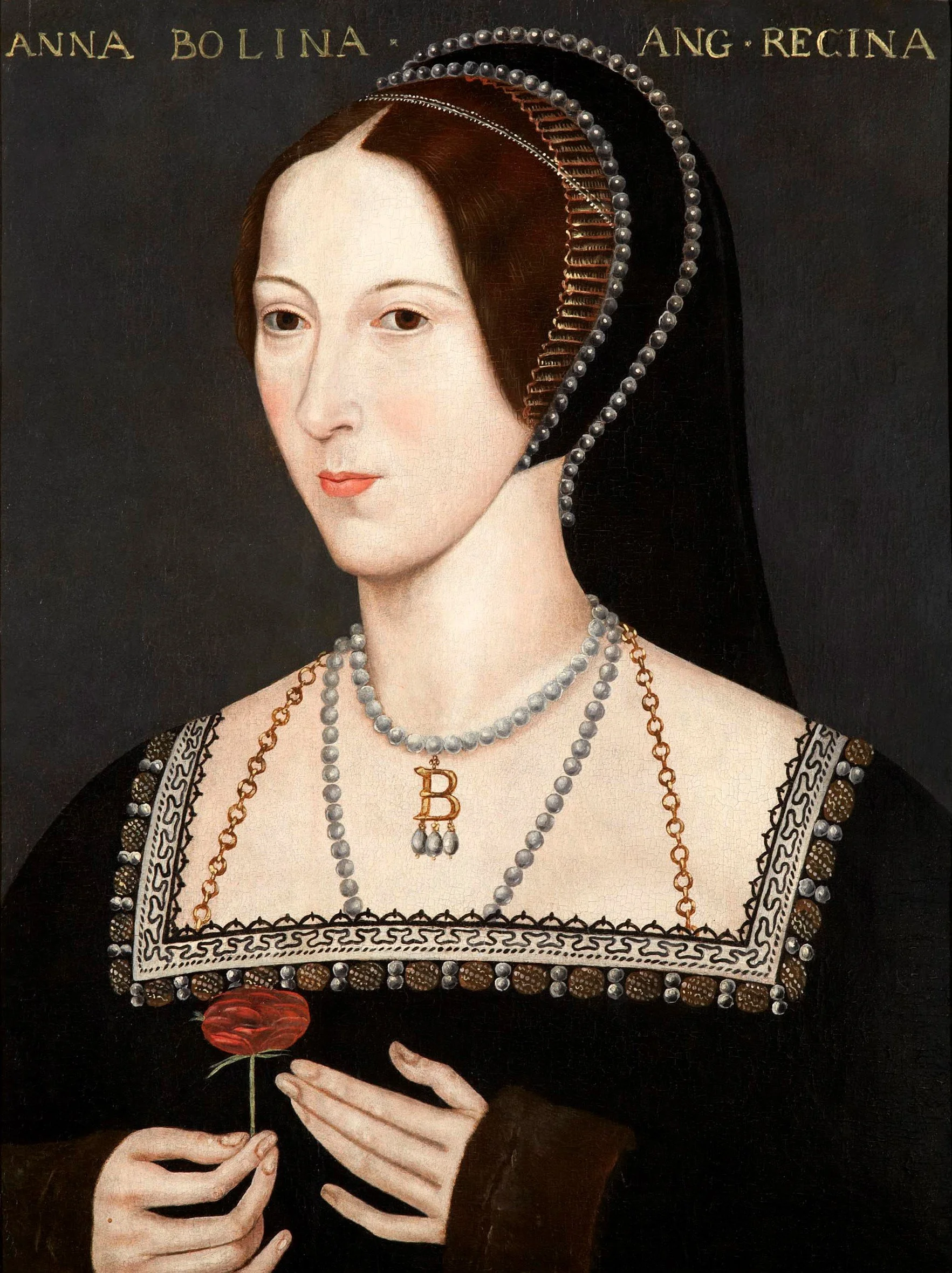
In 1509, the house and estate passed to King Henry VIII upon the death of Henry VII. In 1518, the King exchanged the house and what was called then “its Park” to Thomas Boleyn for his Newhall Manor in Essex. (Note here that historical records show that Henden was “disparked” by the mid 16th Century.). Before that time it is widely recorded in state papers that the King stayed at Henden Manor while he was courting Anne Boleyn. He regarded Henden as being more private than the Boleyn’s fortified castle at Hever. Henden served as a convenient and discrete stopping point for him.
It is worth noting here, too, that because of its proximity to Hever Castle, the Boleyn family home, Henden Manor is often mentioned in historical accounts of Anne Boleyn’s childhood.
King Henry VIII married Anne Boleyn, his second wife, in January 1533 while formally he was still married to Catharine of Aragon. Anne was executed in May 1536. In March 1537 Sir Thomas leased Henden to Robert Cranwell, his servant, until 1539 when Sir Thomas died, a broken man. In addition to losing Anne, his son George had been executed and his wife had died. With Sir Thomas’s passing the estate passed to Mary Boleyn and her second husband, Sir William Stafford. Stafford’s marriage to Mary in 1534, however, had greatly angered both King Henry. The marriage had been done in secret and Henry VIII felt insulted that his former mistress and sister-in-law had lowered herself to wed a commoner. He felt that this reflected poorly on the dignity of his own family circle. So, in 1541, Henry VIII compelled Stafford and Mary to “a Forced Exchange”: Henden Manor and its estate for lands in Yorkshire, miles away from the South East and the Royal Court. Henden, therefore, once again came under the possession of the Crown.
For one to two years Henden was tenanted to ThomasForster and his family, with the role of managing the estate for the Crown. In 1543, Henry VIII granted the Manor to Sir John Gresham in recognition of his services. John was a member of the Royal Household from 1527 to 1550. He was a highly successful merchant and financier, who also acted as an agent for Cardinal Wolsey. Using his wealth John bought the manors of Titsey, Tatsfield, Westerham and Lingfield, all reasonably close to Henden. He also owned estates in Norfolk and Buckinghamshire. He founded the Gresham School in Holt, Norfolk. Sir John died in 1556 and Henden passed to William Gresham, who was late knighted for services to the Crown. Sir William died in 1579 with Henden passing to his son also named William Gresham.
Stuart times and later
Henden continued to be owned by William and his family through to 1591 when he sold the estate to Charles Hoskyns (some write it as Hoskins). Charles bought the early 17th century Barrow Green Manor near Oxted around the same time. (In the 1974, this Manor was bought by Mohamed Al-Fayed of Harrods fame.) Charles was part of a rising class of London merchants who used their wealth to buy up estates from older, established families like the Greshams, who were looking to rationalise their holdings.
The Hoskyns retained the estate for over two centuries. Charles died in 1597 and the estate passed to his son, Thomas Hoskyns(he was later knighted by King James I). In 1615, the ownership of the estate passed to Charles’s grandson, also named Charles Hoskyns. He owned it through the Civil War until his passing in 1657 when the ownership passed to William Hoskyns, Charles’s son. In 1712, William died and another Charles Hoskyns became the owner of the estate. He died in 1767 and in 1768 the estate’s ownership passed to Susannah Hoskyns (later Susannah Chicheley Gorges). Upon the deaths of Susannah in 1798 and of her husband Richard in 1806, the Estate passed to her aunt, Katharine Hoskyns, widow of the Reverend Leigh Master of Newhall, Lancashire and thereafter descending to the Hoskyns-Master family. This was a classic example of “inheritance through the female line” that kept the estate stable. In late 1926, Charles Hoskyns Master sold Henden to the Barrow Green Estate Company, a company, which he established in that year. This was becoming an increasingly common move among the land-owning families at the time as they were struggling with death duties (inheritance tax) and the rising costs of maintaining large manors after World War 1.
The Hoskyn family resided at Barrow Green Court during their ownership of Henden, allowing various tenants to manage and farm the estate. Over the period of roughly 1700 to 1740 the tenants were the Forsters family. They were members of the Kentish gentry; Esquires, a rank below Knight. This allowed them to serve as Justices of the Peace and other roles in government of Kent. By this time Henden Manor was over 200 years old and it would have been a prestigious seat for the family to live in. The time when the Forsters were at Henden represented the era when Henden transitioned from a Tudor powerhouse to a Georgian country estate.
In 1740, the Sanderson family became tenants and remained so until around 1870. In records at this time the estate was sometimes referred to as Heathenden Farm. During their tenancy the Sandersons transformed the Manor house from a drafty late-medieval “Hall House’ into a more modern and comfortable residence. They inserted the intermediate floors in the Great Hall (creating two levels where there was once one high ceilinged room), creating smaller rooms, adding dormer windows, modernising the chimneys to allow for private fireplaces in bedrooms and installing the characteristic wood panelling that still exists today. So, when you look at Henden today the visual silhouette is largely down to this family.
In between 1870 and 1926, which was largely the time of the agricultural depression in the UK, the estate was managed more directly by the Hoskyns Master’s land agents or short-term agricultural tenants.
The 20th Century and later
Over the period 1933 to 1937, Henden and its estate was leased to Michael Balcon (knighted in 1947), the legendary film producer. He was also grandfather of Daniel Day-Lewis. During his lease it appears that Michael used Henden as a high society hub for the British film industry. A particular friend of his was Alfred Hitchcock, who became a frequent visitor. It was during this time that Michael, who was head of Production as Gaumont British Pictures, played a key role in assigning or approving the films Hitchcock directed, namely: the Man Who Knew Too much (1934); the 39 Steps (1935); Secret Agent (1936); Sabotage (1936); and Young and Innocent (1937). In 1936, Michael was made head of MGM British. In 1938, after he had left Henden, Michael took over the Ealing film studios from Will Barker and began to release films under the Ealing flag, so starting what many regard as the golden age for the Studio.
In 1937, when Michael still held the lease, the Estate was put up for sale and was bought by Robert Spear Hudson MP, later Viscount Hudson. In 1940, Hudson became the Agriculture Minister in Sir Winston Churchill’s government. Sir Winston Churchill’s home, Chartwell, lies 1.8 miles to the north west as the crow flies.
In 1939, Hudson sold the Manor and estate to Geoffrey Philcox, an industrialist and a man of practical vision. According to Geoffrey, the farm was then in a derelict condition, although the house had a noted Italianate Garden, which was much admired by David Balcon, Alfred Hitchcok and other guests. Sadly, Geoffrey was compelled to dig this garden up during the period of the Second World War to make room for food production as part of the “Dig for Victory” campaign. The ornamental terraces were replaced with functional crops to support the local food supply.
Geoffrey owned Henden during a period when many historic homes were being demolished or falling into total ruin. His decision to invest in the farm’s infrastructure while preserving the moated 15th-century house ensured Henden’s survival into the late 20th century.
In 1978, Philcox sold the estate to Ronald J. Scott, who at considerable personal expense fully restored the house and moat, adding a swimming pool and garage complex as well as some greenhouses and a tennis court. Scott was an interesting person. He was a successful financier and in 1973 at the age of 29 was posted to the UAE by the UK Government. In the UAE he played a pivotal role in establishing the UAE Currency Board, which was designed to manage the country’s current and reserves. He managed the introduction of the UAE currency, the Dirham, to replace the use of the Bahraini Dinar and the Qatari Riyal in the country. At the end of 1980, after Ronald had left in 1978, the Currency Board was transformed into the Central Bank of the UAE.
In 1992, Scott sold the house to Roger Sparks a property developer, who had lived previously in Champions Place in Limpsfield Chart. In 1993, Roger sold Keeper’s Cottage and half an acre or so on the estate.
In June 1997, Roger sold the estate to my wife and I, Roni and Martin Lovegrove. We loved the place upon first sight, but in truth could not afford it at the time. Despite that we borrowed heavily to fund the purchase, thinking that perhaps we might be able to live at Henden for three years or so. As it so happens, we were lucky in business not associated with the estate and are still here some 28 years on.
In 2003, we sold the Lodge on Ide Hill Road in 2003, but later increased the acreage of the estate by buying three large fields to the north of the estate and a smaller field to the far south in 2008. The larger fields had been part of the estate previously, but had been sold to a neighbouring farmer in 1976. It was right to buy them back in. In 2013, we bought a further 18 acres of land within quarter of a mile of the Estate so as to have more acreage on which we could grow food for the cows that we had at the time. Today, we own some 503 acres and every year invest in improving the environment so that the rage of flora and fauna increases.
Over the years we have invested heavily on infrastructure and maintaining the land and in improving the environment. As for our home, the Manor and its large gardens, we have upgraded the facilities here and there including the gardens, although the quality of the work that Scott invested in the Manor remains largely untouched. In 2014, we dredged the moat finding along the way an onion bottle, which dates back to around 1700.
So, after close to 28 years of living on this historical estate we still pinch ourselves every day appreciating how lucky we are to own this magical, historical estate. We are not of the same standing as most of the previous owners, but fully understand the privilege of being the custodians of such a beautiful and peaceful place. One day we will pass this place on to someone else.
Finally, as we worked on this history of Henden and experience the erratic weather patterns that we do today we thought it would be interesting to understand what the climate was like at Henden and in Kent generally during Tudor times. This is included in the section on Weather Data. It makes for really interesting reading. We hope you will agree.